
The documents you use to pitch your film can be just as important as the script itself. A one pager, sometimes known as the one sheet, is your first hurdle in getting an executive to take note of your project and decide whether they want to learn more.
In other words, it’s incredibly important.
The one sheet is your elevator pitch; it’s your opportunity to sell someone on your movie with a single piece of paper. That’s a tall order. Producers and agents might have 100 different one pagers land on their desks in just one week so yours has to stand out.
Keep reading to learn how.
- What is a One Sheet?
- How to format a One Pager?
- Elements of a One Pager:
- One Pager Example:
- Top One Sheet Tips for Success:
What is a One Sheet?
A one sheet or one pager is a pitching document that tells an executive everything they need to know about your film on one piece of paper. The one pager should be 500 words or less and contain only the key information required to understand a project.
The document has the challenging job of selling a script without using a single word more than necessary. This is often the first introduction a producer or studio might have to your project meaning it is absolutely crucial to get it right.
The one sheet will sit on top of your pitching packet similar to a cover letter for a job application. It will give a taste of the film, highlight the unique selling point, and introduce the characters to capture an exec’s interest so that they want to learn more.
Read More:
The Best and Only Script Outline You’ll Ever Need
Screenplay writing advice to not just start but finish your script.
How to format a One Pager?
Although there aren’t exact strict deadlines, there are formatting guidelines that can help lead you on the right path towards a successful one sheet.
- Length: A one pager must not run longer than one A4 piece of paper (or 8.5 x 11 inches in the US). It’s this short out of respect to the busy executives who don’t have time to read anything longer than a few paragraphs on each project.
- Word Count: A rule of thumb is to keep your one sheet between 450 and 550 words to ensure it comfortably fits on the page.
- Text: You are welcome to play around with font to find something that best represents your project, however, make sure it is easily legible from a distance and that the font does not in any way distract from the content itself. A great starting point is to compare your text to Arial size 11.
- Title: A one sheet should have the project’s working title, writer, and genre clearly displayed at the top of the page so that a reader knows exactly what project the document represents. You may also want to include the format (feature, limited series, episodic) at the top as well.
Read More:
Screenwriting Terms: How to Format a Script
Absolutely everything you need to know about screenplay terms including script elements, screenwriting software, and what to avoid when working…
Elements of a One Pager:
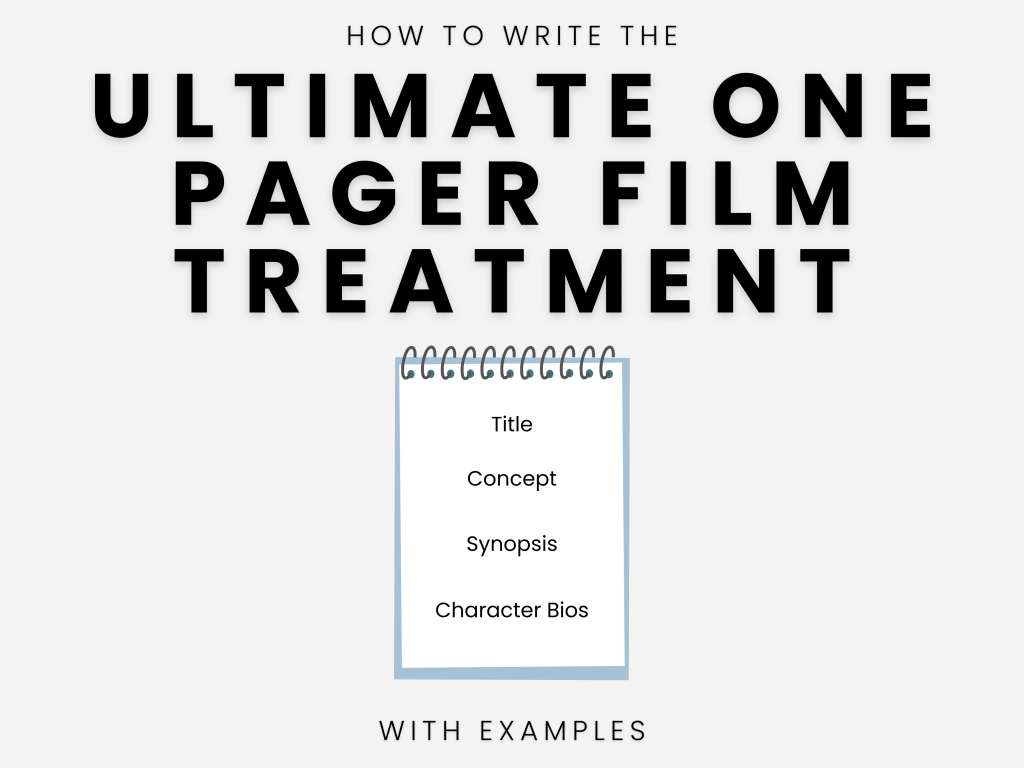
The one pager will consist of the key details, logline, concept, and synopsis. If the word count allows, you may also want to include additional elements like character bios or attached talent.
Here’s a breakdown of what each element consists of:
Title
Hopefully, by this point in the project, you have a great title that you love, but if not, just use your favourite possibility followed by (WT) to indicate that it’s a Working Title.
Credit
Usually the writer, but you may also add a line for ‘Story by’ or ‘Director’.
Genre
Try to keep this short and sweet. You can use fusion genres like Action Fantasy or Crime Romance but try and avoid listing more than two.
Concept
A statement to cover the film’s tone, genre, style, and mission in a broad overview of the story. Keep the concept to no more than three sentences and 80 words. This section should not just be another plot summary, but instead work to create the backbone of why this film is important, different, and needs to be made.
Synopsis
This should be split into a classic three-act structure and written in the third person, not using a screenplay format. This section should be purely about plot, structure, and characters so veer away from any mention of cinematography or editing.
Each act will be a short 2-3 sentence paragraph with the entire section taking no more than 400 words. Distil your story down to only the most important moments, prioritising unique plot twists and character growth.
Ensure this section is focused on the project’s main A-Plot and don’t worry about sharing sub-plots or smaller details, no matter how attached you might be to them. You want the synopsis to be descriptive enough to bring the world to life in the reader’s mind, without relying on descriptive language.
Optional: Character Bios
If word count allows, list the main 3-4 characters with their names, ages, and one sentence to describe them. You can think about this very similarly to how you would introduce a character within the action line of a script, e.g. ‘HARRIET (34), an overworked and overly trusting teacher who’s spent the last year learning how to say no’.
One Pager Example:
Title: TIMES HAVE CHANGED (WT)
Writer: JESSICA SAABOR
Genre: Drama Biopic
Magician Kit sets out to write his first solo show that will share the story of not only his path to finding magic but also the lives of the mentors who came before him.
Concept: Set in the 1920s as the mystique of magic is being broken by the great depression, magician Kit the Enigma is out of work, out of money, and out of opportunities. His mentor, Fernando the Great is sick and it seems as if all hope is lost. But a magician always has a trick up his sleeve. Robbie announces a final show, one that will transport an audience back in time to learn the secrets of his magical forefathers.
Synopsis:
Act 1: KIT THE ENIGMA (28) performs a failing magic act in an almost empty auditorium. As he is about to make his great escape, the police appear, arresting Kit on suspicion of alcohol sales and warning him to give up the craft and get a real job. Using his skills in misdirection, Kit evades the officers and returns to his home to speak with his mentor and magician royalty, FERNANDO THE GREAT (66). Fernando’s health is quickly declining but they cannot afford the surgery needed to save him. Fernando tells Kit it’s time to give up on the future of magic.
Act 2: Kit visits his childhood best friend REBECCA (28) to ask for her advice. They discuss her deceased Father, another great magician, and she shares with Kit that she still has his old magician’s bag. In the bag, Kit discovers a trick like he’s never seen before…the time traveller. He begins work on a new, final show that will take place for one night only and take an audience back in time. He argues with Fernando who tells him that time is the one thing a magician has no right to play with. It is the night of the show and Kit is performing to a sold-out audience. Before going on stage, Kit and Fernando argue once again leading to Fernando collapsing and being rushed to the hospital by Rebecca. Kit refuses to postpone the show and the performance begins.
Act 3: Rebecca reappears just in time to see…her Father materialises on the stage. He is alive but deeply confused and tries to attack Kit. A fight breaks out on stage and Rebecca runs to separate the men. Suddenly they both disappear. Kit reappears moments later, 20 years older. After the show, Rebecca realises what he has done and they argue. She tells Kit she wishes to never see him again. Kit reveals he has a letter for her from her Father telling her that he’s sorry he would not get to watch her grow up. Kit visits Fernando in the hospital to reveal he has the money needed to pay for his health care after working as a labourer for the past 2 decades.
Top One Sheet Tips for Success:
A producer, agent, or executive might have hundreds of one pagers put on their desk every single week. To help yours stand out and guarantee a request for more information, use these five one pager tips for success:
- Focus on the logline: If it doesn’t immediately grab the reader’s attention, they’re not going to keep reading. I would go so far as to say the logline is the most important part of any one pager. It can’t be more than one sentence and needs to introduce the protagonist, capture the story hook, and tell the reader exactly what makes this story special.
- Steer clear of the camera: The one pager should be about story, story, story. Cinematography, sound, and editing will all come later. Don’t waste valuable word count on describing camera angles or shooting style – the concept alone should be enough to sell this project.
- Consider your USP: You are going to get this project greenlit based on its Unique Selling Point. That means finding the specific thing that makes this film different and the reason it is going to attract an audience. Film is a business and no matter how artistically beautiful the concept might be, all a studio cares about is whether or not it will turn a profit.
- Let go of the details. These can come later. The one sheet is a big-picture document that just needs to sell the broad strokes of your project. Try thinking about it like a trailer – a short piece that gives a taste of the movie without focusing on specifics.
- Get it proofread. Ideally by someone who has no idea what your project is about. When you’re close to a story, it can be all too easy to subconsciously fill in the gaps when it comes to the synopsis and not realise that you’re missing crucial information. Get a friend or colleague to read it over and ask them to describe back to you what the film is about. This will give you great insight into what the one sheet is actually saying.
Writing a one pager is a daunting task, the good news is that it’s short and sweet. If you’re really struggling, try creating multiple options and ask those around you for feedback on which is best. The time it takes to create the ultimate one pager will be so worth it once you get that studio call.
After the one sheet comes the treatment. Read my Guide to Writing the Perfect Film Treatment to secure that greenlight.



 Gone Travelling Productions
Leave a comment