
The first big mistake I made as a content writer was writing in the completely wrong style. I was working on a set of five trial articles that were supposed to be in a conversational tone…and let’s just say what I submitted was way off.
Luckily, the client came back with feedback on how to adjust the tone and gave me another chance to fix it.
Ever since then, I’ve made sure to know exactly the writing style I need to shift into depending on the client. Sometimes this is highlighted in the style guide, but often it’s a matter of scanning through already published content and deciphering the tone myself.
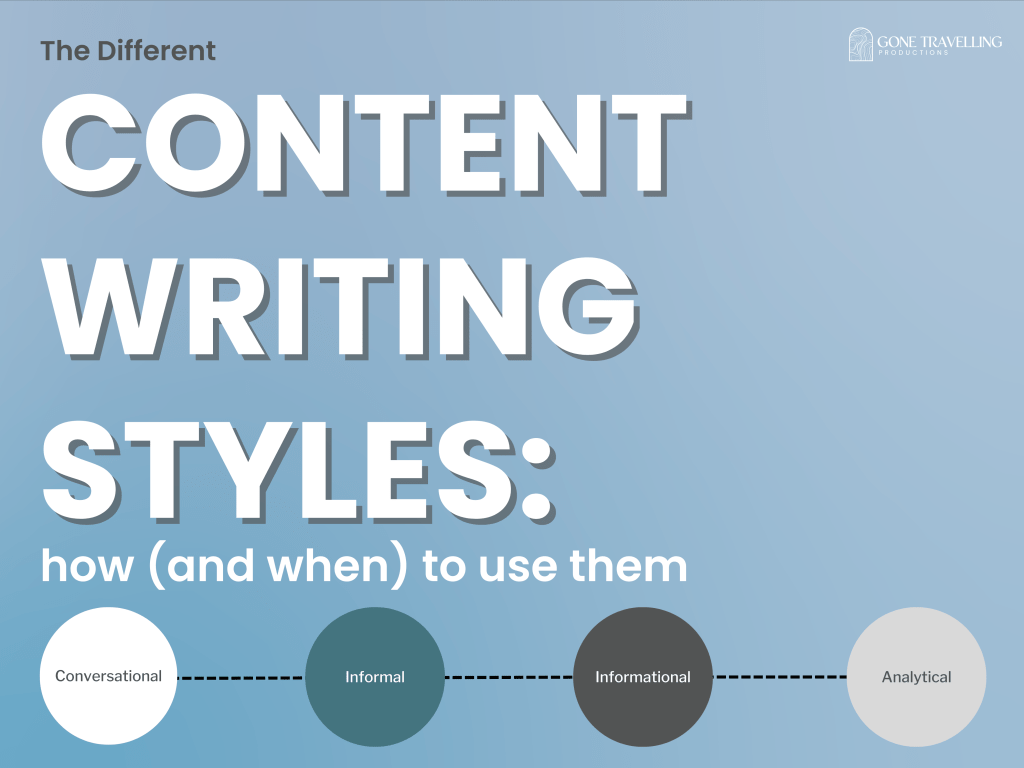
To help you avoid my mistake, I’ve created this guide to the five most common writing styles for content writing, as well as when to use them.
- Conversational Writing
- Informal Writing
- Informational Writing
- Analytical Writing
- Narrative Writing
- Style Guides: AP, Chicago, APA, and MLA
- Choosing Your Freelance Writing Niche
Conversational Writing
Conversational writing is the ultimate casual writing style. It isn’t concerned with perfect grammar and complex sentences, and instead prioritises relatability and easy flow. You’ll often include dashes, ellipses (…), and even jokes when writing in this style in order to make it feel more like chatting with a friend than sharing information.
This style is familiar and low-key. You’ll most likely be writing in first-person (I, me, my) or first-person collective (we, us, our) and addressing the reader directly. Conversational writing doesn’t need to hide personal opinions and even leans into them explicitly with phrases like “to be honest”, “if I’m being real”, and “I have to admit that”.
When to use it: Blogs, newsletters, and social media
Conversational Writing Dos and Don’ts
Do…
Be playful with grammar
Make jokes
Use first person and first person collective
Don’t…
Overthink it
Use a superlative vocabulary
Be neutral
Informal Writing
Informal writing remains casual but without the familiarity of the conversational style. The writer takes a more neutral position, avoiding the first-person and not inserting too much personality. Think of informal writing as the sweet spot between being overly friendly and too cold.
To achieve this, the writing should remain easily digestible with a relaxed and lighthearted tone, with information presented in a straightforward manner. Flow also remains important for informal writing, as you want a reader to seamlessly glide through text—things like contractions and dashes will help with this.
When to use it: Travel and lifestyle content
Informal Writing Dos and Don’ts
Do…
Keep vocabulary and sentence structure simple
Write in the second person (you, your)
Focus on flow
Don’t…
Be overly familiar
Make the writing too formal
Sacrifice clarity for personality
Informational Writing
Informational writing is typically used with more academic or high-brow content. Its main objective is to convey information (whether that’s statistics, instructions, or scenarios), which is why clarity is key. Opt for directness, avoid overly descriptive language, and include numbers and specific examples wherever possible.
Remember that with informational-style writing, you’re not overtly trying to persuade or influence (although this may still be a secondary factor in marketing content writing). Instead, focus on finding facts to sway a reader’s understanding of a situation or product.
When to use it: Technical, science, or medical articles, SAAS product descriptions
Informational Writing Dos and Don’ts
Do…
Use facts and figures
Prioritise clarity
Define technical terms
Don’t…
Insert personal opinions
Bombard readers with information
Ignore flow altogether
Analytical Writing
While informational writing presents ideas, analytical writing evaluates them. You’ll likely use this style for things like case studies, more formal opinion pieces, and even product comparisons. Essentially, you’re breaking down the elements and drawing conclusions in a useful way for a reader.
This style allows for some personal opinion, but only when backed up by examples or data. You should aim to keep a logical throughline with this writing that closes on a clear standpoint. Your tone should veer slightly more on the formal side, choosing precise and topic-specific language to bring a sense of legitimacy to the piece.
When to use it: Product or service reviews and comparisons, tech content, case studies
Analytical Writing Dos and Don’ts
Do…
Draw evidence-based conclusions
Present facts and figures
Include technical or subject-specific jargon
Don’t…
Use an informal tone
Make sweeping or overgeneralised statements
Rely on personal feelings instead of facts
Narrative Writing
Narrative writing tends to be the most flowery or free style. It’s used to paint a picture in the reader’s mind and take them on a story. Narrative writing is especially useful for marketing, where you want to build an emotional connection between the reader and the product/brand you’re writing for.
You have to have a clear outline before diving into narrative writing that involves a beginning, middle, and end. In the opening, you’ll establish a problem/challenge, use the middle to show how it might be overcome, and finish with an impactful ending. Consider how you want the reader to feel at each of these story beats and play around with ways to achieve that response.
When to use it: Product descriptions, long-form articles, blog posts
Narrative Writing Dos and Don’ts
Do…
Use adjectives, metaphors, and similes
Consider the beginning, middle, and end
Experiment with your writer’s voice
Don’t…
Rely on clichés
Worry so much about facts and stats
Overuse technical language
Style Guides: AP, Chicago, APA, and MLA
AP, Chicago, APA, and MLA are the most common editing styles used today. They essentially provide grammar, vocabulary, and formatting guidelines to create consistent content writing.
Not every style guide uses a specific editing style (especially in more casual writing), which is why it’s so important to deep dive into the already published content to note their preferences.
Here are some of the key differences between AP, Chiacago, APA, and MLA:
AP vs Chicago Style Differences
| Writing Style Element | AP Style | Chicago Style | APA Style | MLA Style |
|---|---|---|---|---|
| Title | Capitalise all words with four or more letters | Capitalise the most important words only | Capitalise the most important words only | Capitalise the most important words only |
| Oxford Comma | Generally not used | Always used | Always used | Always used |
| Numbers | Spell out numbers one through nine | Spell out numbers zero through ninety-nine | Spell out numbers one through nine | Spell out numbers one through nine |
| Date Format | Month Day, Year (e.g., Jan. 1, 2025) | Month Day, Year (e.g., January 1, 2025) or Day Month Year (e.g., 1 January 2025) | Year, Month Day (e.g., 2025, January 1) | Day Month Year (e.g., 1 January 2025) |
Choosing Your Freelance Writing Niche
In most cases, the style you write in will be dictated by your niche and clients. For instance, travel blogs tend to choose informal writing, whereas tech publications prefer analytical. To find your niche, check out my guide below:
Read More:
Choosing a Freelance Writing Niche: A Complete Guide for Beginners
A freelance niche list that breaks down content writing niches, copywriting niches, and the highest paying freelance niches.

 Gone Travelling Productions
Leave a comment