
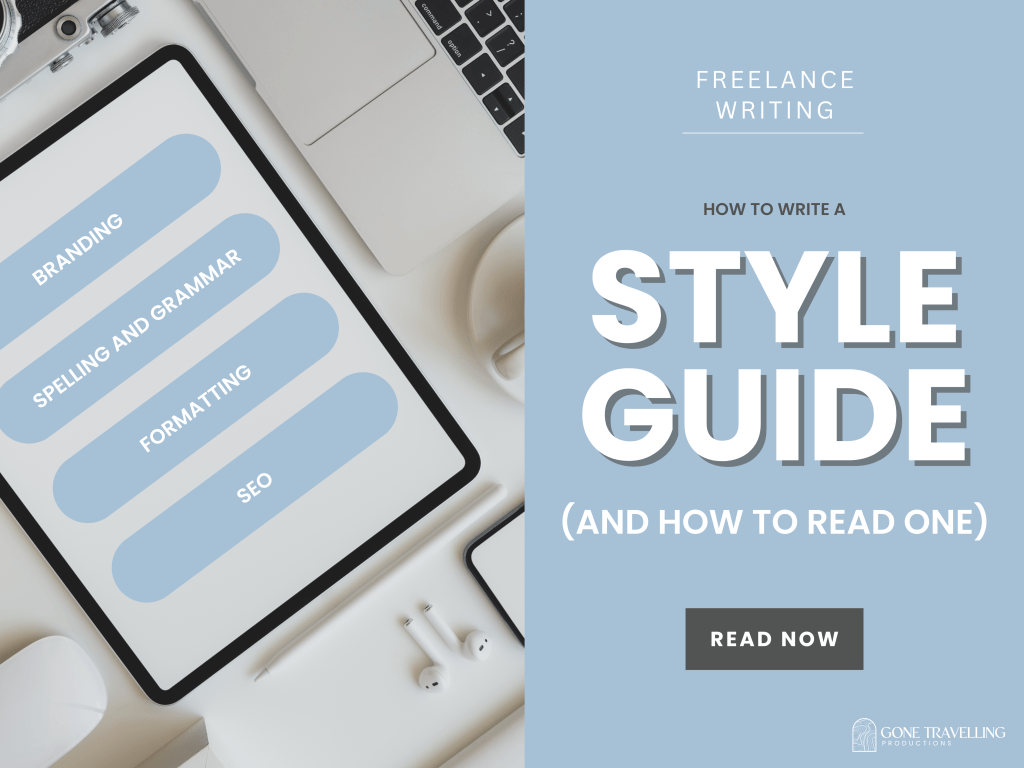
Knowing how to write (and read) a style guide is one of the most overlooked steps in the content process. A great style guide streamlines content style, keeps it consistent, and saves both writers and editors a ton of wasted time.
As a freelance content writer, I’ve worked with a lot of different style guides…and I promise, not all are created equally. That’s why I’m using this post to break down the elements of a style guide to prioritise a strong brand voice and an efficient content workflow.
- What is a Style Guide?
- The Elements of a Style Guide
- How to Use a Style Guide
- Looking for a Content Writer?
What is a Style Guide?
A style guide is a document that tells a writer how to create content in line with a brand. It covers everything from spelling to brand voice and even phrases to avoid. In essence, with the style guide in hand, a writer should be able to create written content to perfectly fit on a website, without ever even opening the site.
Style guides are usually sent to a content writer before they begin work on their first project for a brand, sort of like a content bible. The document could be anywhere between one and twenty pages long, with clear enough guidelines to lead a writer’s content without constricting it.
The Elements of a Style Guide
Every style guide is going to be a little different, but most share at least a few fundamental similarities. Here are the elements of a style guide that you should know about:
Branding
Potentially the most important part of a style guide is the instructions on how to capture the essence of the brand. This covers things like tone of voice, writing style, and formality in order to break down the brand’s unique POV.
Branding will tell a writer if the content should be casual vs formal, informational vs descriptive, and using first, second, or third person. Part of this will also include sharing details about the content’s audience e.g. age, demographic, and industry.
To guide a writer even further, style guides may contain a list of dos and don’ts or a ‘things to avoid’ section to clearly convey the rules of a particular brand. Here’s an example:
Things To Avoid:
- Using absolute statements
- Comparisons to other brands
- Negative or pessimistic words
- Words that emphasise “otherness”, such as foreigner and tourist
Read More:
The Different Content Writing Styles: how (and when) to use them
Perfect the five most important content writing styles as well as AP, Chicago, APA, and MLA, and learn when to…
Spelling and Grammar
It wouldn’t be a style guide without touching on the technical specifics for written content. In its simplest form, this section will inform a writer of things like:
- Language, e.g. British vs American English
- Punctuation preferences, e.g. the use of the Oxford comma or ellipses
- Editing style guide, e.g. if they use AP or Chicago style for copyediting
It should be implied that a professional content writer uses correct grammar in all instances, but there are subjective rules within this, especially when working with more casual clients.
If a brand has strong feelings about things like the passive voice, quotation marks, and the Oxford comma (which I certainly do), then it should be clearly stated in the style guide.
Formats and Style Conventions
If a style guide mentions the use of a particular editing style guide, like AP, then this will probably already cover a lot of formatting and style conventions. If a brand doesn’t stick like glue to another guide, then their preferences should be written in the style guide.
Style conventions deal with simple things like how to format a date to whether to use numerals or type out numbers (1 vs one), and the controversial decision on title capitalisation. For websites that regularly discuss places or events, their address conventions should be included too.
I work with a lot of travel companies with content spanning across different countries. With these clients, I really appreciate guidance when it comes to country names, foreign words or phrases, and international naming conventions.
SEO
There isn’t a single content writing element that isn’t connected with SEO in one way or another. So that optimisation can happen at every level, a brand needs to share its SEO strategy and preferences.
This may vary depending on how a website works with writers – e.g., if they require them to do research/SEO strategy – but on a base level, the site’s link strategy and SEO formatting should be specified. This means things like internal link guidance, and how long to make text between H2 headings.
For more extensive style guides, the SEO element may also encompass their metadata and primary/secondary keyword frequency preferences.
Final Checks
A final checks section in a style guide helps a writer to spot any easily fixed issues and quickly rectify them before submission. In most cases, a writer will only need to refer to this list the first few times submitting to a brand before starting to automatically consider them as they write.
One way to write the final checks is in the form of a series of questions. Here’s another example from a real-life style guide I have worked with:
- Have I added a title and subtitle?
- Have I included an introduction?
- Have I proofread it?
- Have I done a grammar check?
- Have I avoided passive voice?
- Have I avoided clichés?
- Have I fact-checked my work?
- Have I followed the AP Style guidelines?
It is also a great idea to include example links to previously published content on the site. This helps writers to have a real piece to reference and base their content on.
How to Use a Style Guide
There’s no point in style guides if they aren’t used effectively. Here’s how to do just that:
For Clients
If you’ve gone to the effort of writing a style guide, then you don’t want it to go to waste and get covered in digital dust in your files. The best way to use a style guide as a brand is to implement it into your workflow when onboarding new creatives and content specialists.
When welcoming anyone involved with content onto the team, whether they’re freelance writers or full-time SEO strategists, it’s crucial that they are sent a copy of the style guide and asked to go through it thoroughly.
From that point, you can direct them to the style guide for any minor questions, as well as refer back to it yourself to make sure that the content stays consistent.
For Writers
As a content writer, the style guide cannot and should never be ignored. This document is your golden ticket to a happy client from the first submission, with the answers to your many questions waiting within.
First things first, study the style guide from front to back. You should read over everything and look up anything you’re not sure about, such as the details of AP style. While writing content, you will also find yourself cross-checking against the style guide regularly to make sure formatting and text are consistent.
I also recommend going through any final checks before submitting. If the style guide doesn’t have an explicit final checks section, then it’s a good idea to quickly make your own with a few elements you want to make sure not to forget or overlook.
Need help finding your writing niche?:
Choosing a Freelance Writing Niche: A Complete Guide for Beginners
A freelance niche list that breaks down content writing niches, copywriting niches, and the highest paying freelance niches.
Looking for a Content Writer?
Writing a style guide in anticipation of finding a new content writer? You’ve come to the right place! Check out my portfolio and get in touch for my content writing rates.



 Gone Travelling Productions
Leave a comment